
Writing happens at the intersection
of discovery and storytelling.
From brainstorming ideas to the process of documenting and writing, I enjoy connecting the dots by analysing patterns and synthesising knowledge. I find writing quite a meditative process to craft compelling narratives.
2024
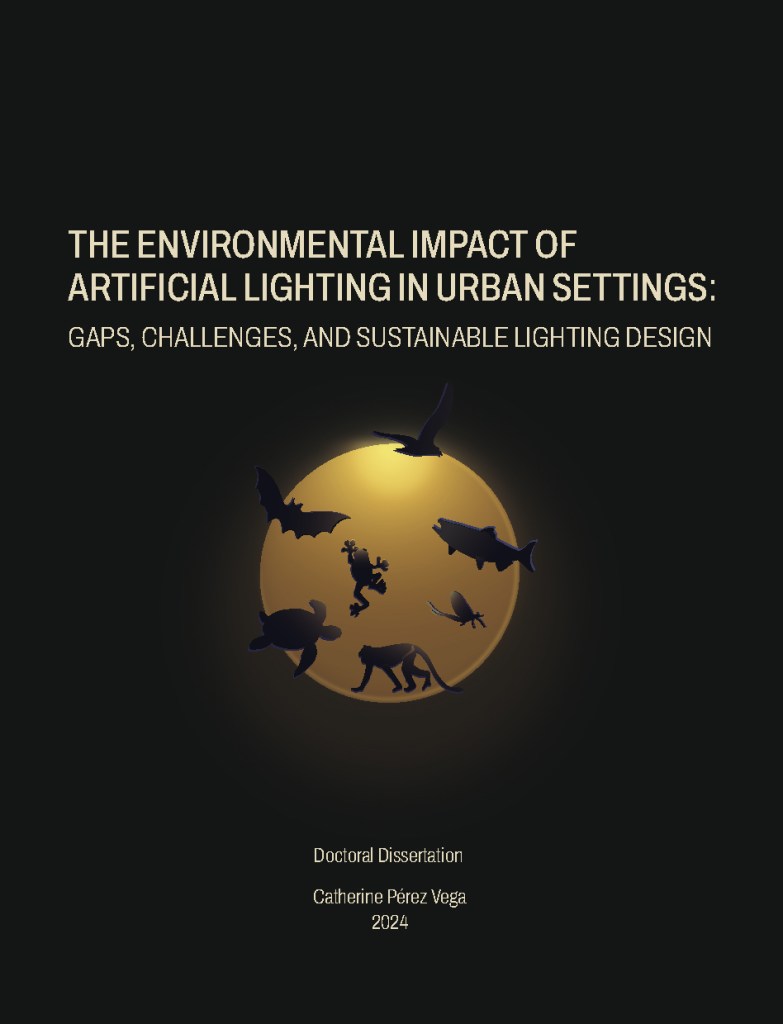
The environmental impact of artificial lighting in urban settings: gaps, challenges, and sustainable lighting design.
Doctoral dissertation
With a focus on aquatic habitats, this dissertation explores the environmental consequences of artificial light at night. Highlighting the need for collaborative and transdisciplinary approaches between experts in the research and practice of lighting, this dissertation shows the existing knowledge gaps on ecology on the subject of light pollution, the challenges and the potential solutions when illumination is needed near aquatic habitats.
Key elements included:
• Perspectives from the lighting design practice;
• Studies on night ecology, light pollution and cities at night;
• A proposal on responsible approaches towards night-time illumination.
2024
Polarised light pollution on river water surfaces caused by artificial light at night from illuminated bridges and surroundings
Research Article
Pérez Vega, C., Hölker, F., Zielinska-Dabkowska, K. M., & Jechow, A. Polarised light pollution on river water surfaces caused by artificial light at night from illuminated bridges and surroindings. Journal of Limnology. 83 (1).
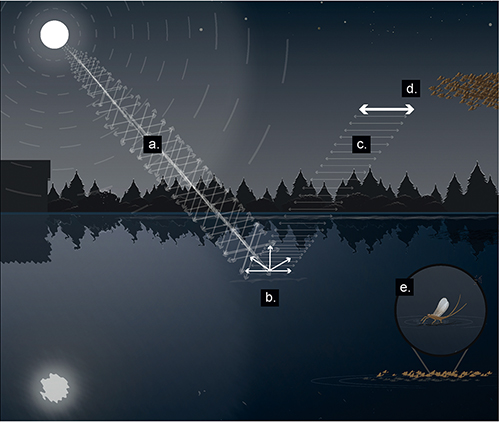
Bridge illumination gave rise to night-time illuminated paths across aquatic systems. However, if bridge artificial light at night reach waterbodies, it can result in polarised light pollution, which might alter the optical conditions of a river by night and potentially interfere with moonlight polarisation signals reflected off the water’s surface. It is a night-time phenomenon that can detrimentally change the behaviour of organisms sensitive to horizontally reflected polarised moonlight, a navigational cue and signal known to be used by flying water-seeking insects to detect suitable aquatic habitats to reproduce and lay eggs.
Key elements included:
• A study that quantifies the reflection of artificial light at night- induced polarisation patterns at the water’s surface near seven illuminated bridges crossing the river Spree in Berlin.
2024
Light pollution from illuminated bridges as a potential barrier for migrating fish – Linking measurements with a proposal for a conceptual model
Research Article
Pérez Vega, C., Jechow, A., Campbell, J. A., Zielinska-Dabkowska, K. M., & Hölker, F. (2024) Light pollution from illuminated bridges as a potential barrier for migrating fish–Linking measurements with a proposal for a conceptual model. Basic and Applied Ecology. 74, 1-12.
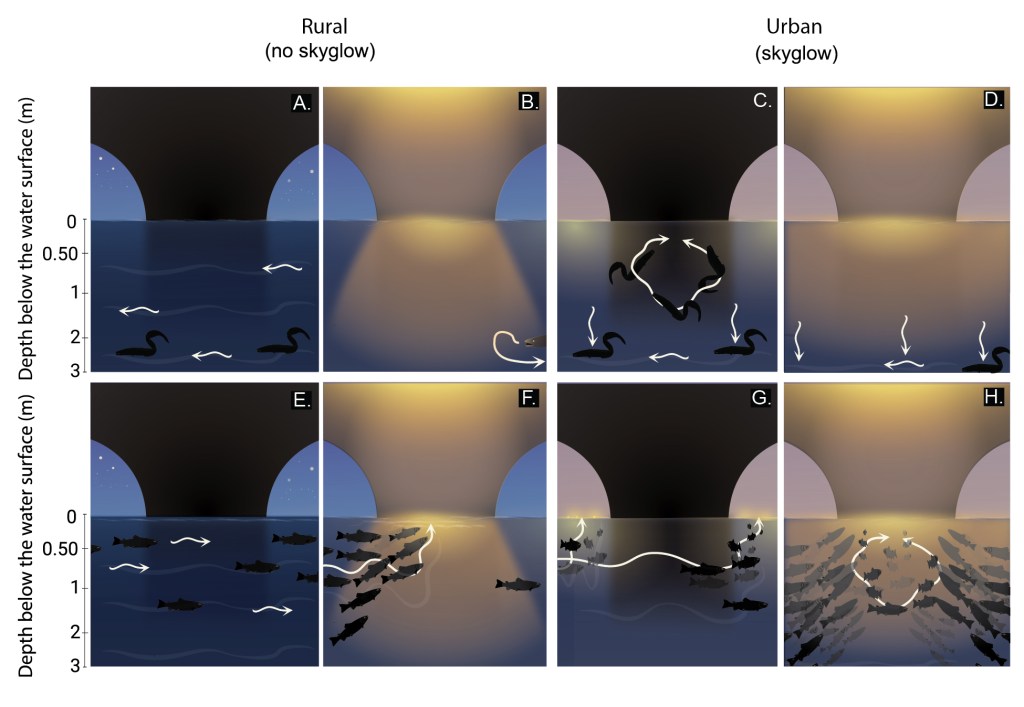
Illuminated bridges have become important assets to navigable aquatic systems. However, if artificial light at night (ALAN) from illuminated bridges reaches aquatic habitats, such as rivers, it can threaten the river’s natural heterogeneity and alter the behavioural responses of migratory fish.
Key elements included:
• A pilot study that quantified levels of artificial light at night at illuminated bridges that cross a river;
• A conceptual model to estimate its potential implications on two migrating fish species with contrasting life histories including Atlantic salmon smolts (Salmo salar) and European silver eel (Anguilla anguilla);
• Night-time light measurements on a transect of the river Spree in Berlin and in detail at seven illuminated bridges.
2022
A Systematic Review for Establishing Relevant Environmental Parameters for Urban Lighting: Translating Research into Practice
Systematic Review
Pérez Vega, C., Zielinska-Dabkowska, K. M., Schroer, S., Jechow, A., & Hölker, F. (2022) A Systematic Review for Establishing Relevant Environmental Parameters for Urban Lighting: Translating Research into Practice. Sustainability. 14, 1107.
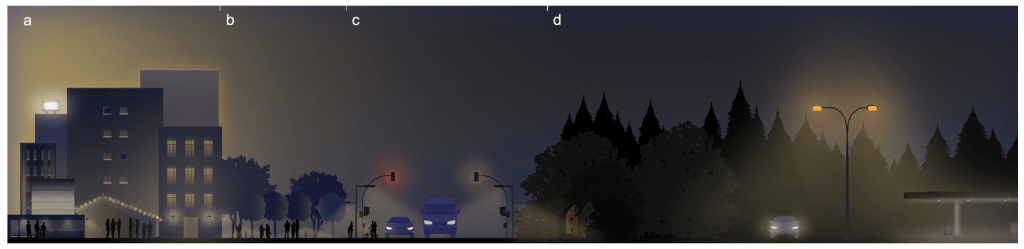
The application of lighting technologies developed in the 20th century has increased the brightness and changed the spectral composition of nocturnal night-time habitats and night skies across urban, peri-urban, rural, and pristine landscapes, and subsequently, researchers have observed the disturbance of biological rhythms of flora and fauna. To reduce these impacts, it is essential to translate relevant knowledge about the potential adverse effects of artificial light at night (ALAN) from research into applicable urban lighting practice. Therefore, the aim of this paper is to identify and report, via a systematic review, the effects of exposure to different physical properties of artificial light sources on various organism groups, including plants, arthropods, insects, spiders, fish, amphibians, reptiles, birds, and non-human mammals (including bats, rodents, and primates). <
Key elements included:
• Systematic review showing the responses of various organism groups to high illuminance levels, duration of light exposure, and unnatural color spectra at night;
• Artificial Light At Night Lingua Franca;
• Key terminologies and definitions connected to natural and artificial light.

2021
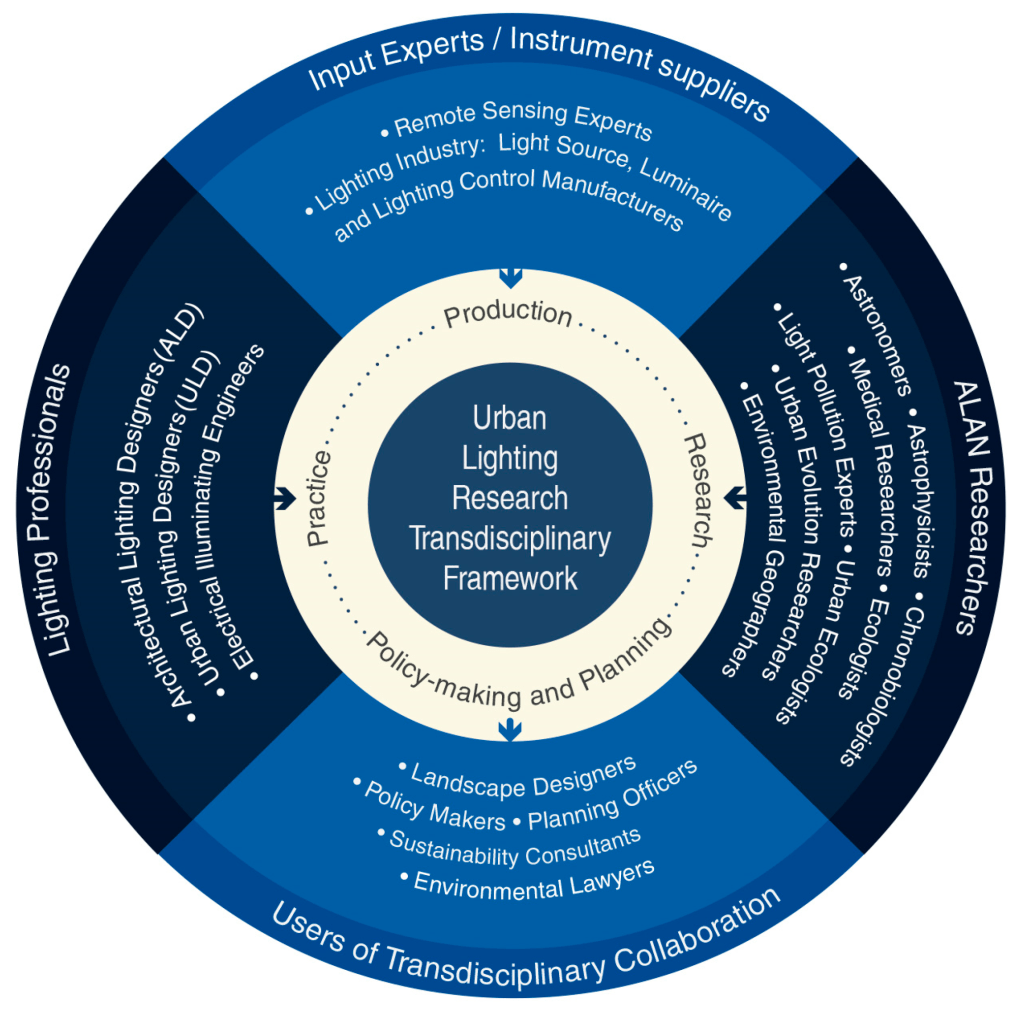
Urban Lighting Research Transdisciplinary Framework — A Collaborative Process with Lighting Professionals
Hypothesis Article
Pérez Vega, C., Zielinska-Dabkowska, K. M., & Hölker, F. (2021) Urban Lighting Research Transdisciplinary Framework — A Collaborative Process with Lighting Professionals. Published in the International Journal of Environmental Research and Public Health. Int. J. Environ. Res. Public Health. 18, 624.
Over the past decades, lighting professionals have influenced the experience of the night by brightly illuminating streets, buildings, skylines, and landscapes 24/7. When this became the accepted norm, a dual perspective on night-time was shaped and the visual enjoyment of visitors after dusk was prioritized over natural nightscapes (nocturnal landscapes). During this time, researchers of artificial light at night (ALAN) observed and reported a gradual increase in unnatural brightness and a shift in color of the night-time environment. As a consequence, ALAN has been identified as a relevant pollutant of aquatic and terrestrial habitats, and an environmental stressor, which may adversely affect a wide range of organisms, from micro-organisms to humans. Unfortunately, lighting professionals and ALAN researchers usually attempt to solve today’s sustainable urban lighting problems distinctive to their fields of study, without a dialogue between research and practice.
Key elements included:
• A collaborative framework involving a transdisciplinary process with lighting professionals to potentially bring the practice, research, production, decision-making, and planning closer to each other.

Catherine Pérez Vega
Designer and Researcher
© Catherine Pérez Vega 2024
 Catherine Pérez Vega